
What Is Bhuta Yajna? Understanding Pancha Maha Yajna in Sanatana Dharma
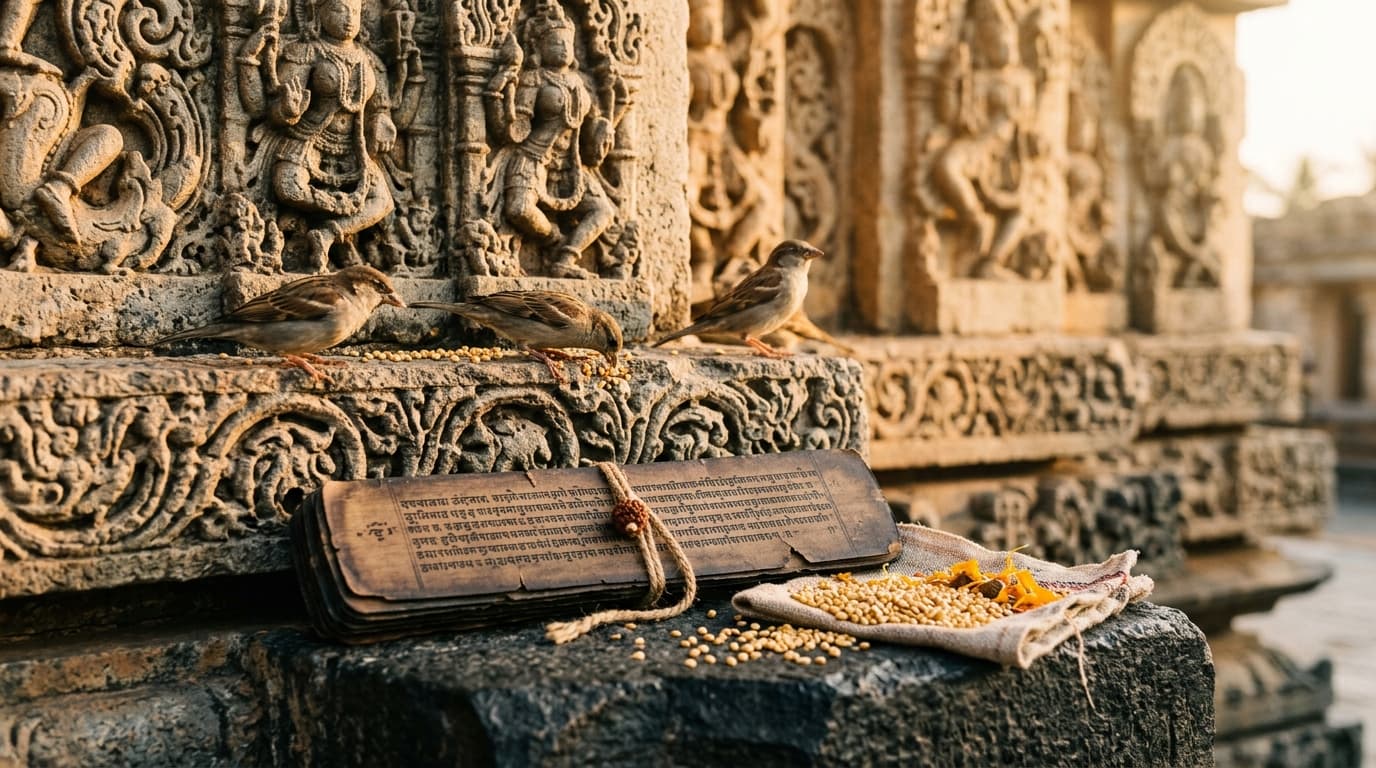
- Bhuta Yajna literally translates to "offering or sacrifice to all living beings."
- It is one of the five daily obligations (Pancha Maha Yajna) mandated for Hindu householders (Grihasthas).
- The practice acknowledges that humans share the Earth with animals, birds, and insects, and owe them sustenance.
- Daily Pakshi Seva (bird feeding) and Gau Seva (cow care) are the most direct contemporary expressions of Bhuta Yajna.
Bhuta Yajna (भूतयज्ञ) is one of the foundational ethical pillars of Sanatana Dharma. Defined in ancient Vedic literature as one of the Five Great Daily Sacrifices (Pancha Maha Yajna), it represents the householder's solemn commitment to live in harmony with non-human life.
Scriptural Foundations of Bhuta Yajna
According to the **Shatapatha Brahmana (11.5.6.1)**, every householder incurs five spiritual debts (Rinas) upon taking up domestic life. To balance these debts and express gratitude to the cosmos, five daily sacrifices must be performed:
1. **Brahma Yajna**: Study and teaching of sacred wisdom. 2. **Pitri Yajna**: Offerings of remembrance to ancestors. 3. **Deva Yajna**: Offerings to cosmic energies through fire or prayer. 4. **Manushya Yajna**: Hospitality and care for fellow human beings. 5. **Bhuta Yajna**: Offering food and protection to animals, birds, and insects.
The **Taittiriya Aranyaka (2.10)** explicitly mandates that before a householder consumes their morning meal, a portion of food must be offered to the wild creatures of the air and earth.
Distinction: Scripture vs. Traditional Practice vs. JEEVA's Modern Role
- **Scripture**: The primary texts mandate the daily physical setting aside of food (*Bali*) for non-human creatures as a core ethical obligation.
- **Traditional Practice**: Families historically scattered unpolished grains (*Jowar, Bajra*) on roof terraces or courtyard mud platforms before breakfast.
- **JEEVA's Modern Interpretation**: For modern urban dwellers lacking physical space or time, JEEVA acts as a ground execution platform, enabling devotees to register a daily Sankalp while ground staff perform verified daily bird and Gau feeding on their behalf.
How Daily Pakshi Seva Fulfills Bhuta Yajna
Pakshi Seva—the daily offering of clean unpolished grains and water to birds—is the most accessible form of Bhuta Yajna in the modern era. When practiced consistently, it transforms daily eating into a sacred act of ecological sharing.
Explore our comprehensive guide on [Pakshi Seva in Sanatana Dharma](/blogs/pakshi-seva-in-sanatana-dharma-scriptural-foundations) or discover how to participate directly through [JEEVA Monthly Plans](/plans).
📜 VERIFIED SCRIPTURAL / FACTUAL SOURCES
- Shatapatha Brahmana (11.5.6.1)
- Taittiriya Aranyaka (2.10)
- Manusmriti (3.68-71)
Frequently Asked Questions (FAQ)
Q: What is the literal meaning of Bhuta Yajna?
Bhuta Yajna comes from the Sanskrit words "Bhuta" (all created living beings, including animals, birds, and insects) and "Yajna" (sacred offering or sacrifice). It means an offering dedicated to nourishing all living creatures.
Q: How is Bhuta Yajna performed in daily life?
Traditionally, householders performed Bhuta Yajna by setting aside a portion of daily grain or food (known as Bali) before eating, offering it to birds, cows, dogs, and wildlife.
Turn Compassion into Daily Action
Register your sacred sankalp today. Our ground coordinators will execute your daily bird feeding and fresh water seva with 100% photo & video transparency.
SEVA SHURU KAREIN